What is BYOIP (Bring Your Own IP)?
 Stephanie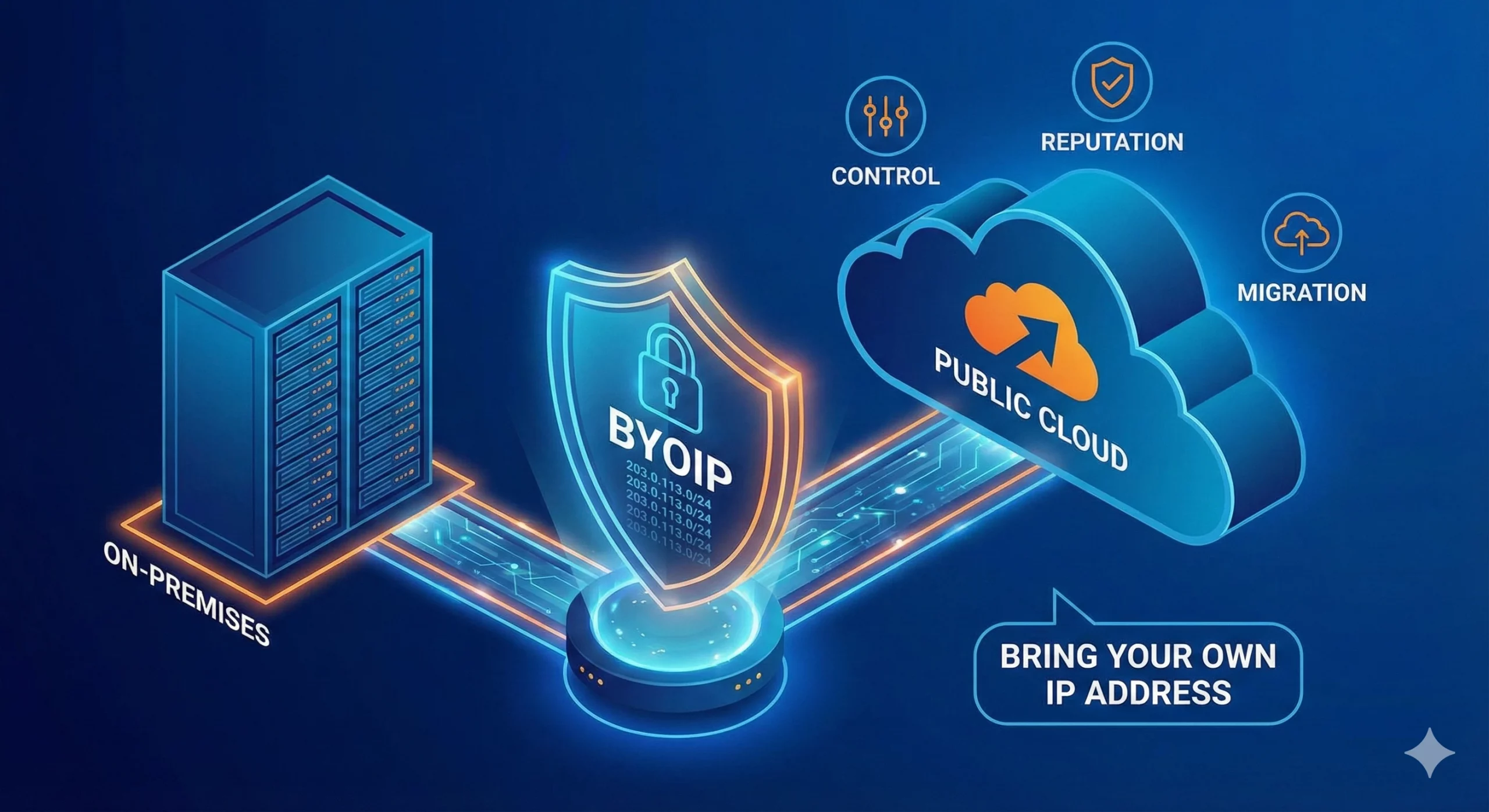
Bring Your Own IP (BYOIP) is a concept in cloud computing and networking that allows businesses to bring and use their own Internet Protocol (IP) address ranges when migrating to cloud service providers (CSPs) or other networking infrastructures. This approach enables organizations to maintain their existing IP addresses instead of adopting new ones assigned by the provider, ensuring consistency, security, and operational continuity.
Table of Contents
Why is BYOIP Important?
Organizations that rely on static IP addresses often face challenges when transitioning to cloud environments. Traditionally, when moving to a cloud provider, businesses are assigned new IP addresses, which can cause disruptions in networking, firewall rules, reputation management, and compliance requirements. BYOIP eliminates these challenges by allowing enterprises to retain control of their existing IP addresses, making the migration process smoother and reducing the risks associated with changing IPs.
Key Benefits of BYOIP
- Seamless Cloud Migration
BYOIP simplifies the transition to cloud platforms, as organizations do not have to reconfigure their applications, security policies, or network settings to accommodate new IP addresses. This reduces downtime and minimizes operational complexity. - IP Reputation Management
Many businesses, especially those in email marketing, cybersecurity, and online services, build their reputation around their IP addresses. Using a new IP can lead to issues such as email deliverability problems and security concerns. With BYOIP, companies can retain their trusted IP addresses, avoiding potential disruptions. - Regulatory and Compliance Adherence
Certain industries, such as finance and healthcare, operate under strict regulatory guidelines that require them to use specific IP addresses for compliance reasons. BYOIP ensures that organizations can meet these compliance requirements without unnecessary modifications. - Improved Security and Control
With BYOIP, businesses retain control over their IP address management, enhancing security and reducing risks associated with IP address changes. They can continue using their existing security frameworks, such as firewall rules, access control lists (ACLs), and intrusion detection systems. - Multi-Cloud Flexibility
Organizations adopting a multi-cloud strategy can use BYOIP to maintain consistency across different cloud environments. This allows for greater flexibility in managing workloads across multiple cloud providers without changing IP configurations.
How BYOIP Works
The implementation of BYOIP varies depending on the cloud provider. However, the general process includes:
- Verification & Ownership Proof: The organization must prove ownership of the IP address range to the cloud provider. This typically involves routing verification via the Regional Internet Registry (RIR) and Border Gateway Protocol (BGP) announcements.
- IP Address Migration: Once ownership is confirmed, the IP range is imported into the cloud provider’s network infrastructure.
- Configuration & Deployment: The organization configures networking policies, security settings, and routing rules to ensure proper integration with cloud services.
- Ongoing Management: The organization continues managing and monitoring the IPs as if they were on-premises.
Conclusion
BYOIP is an essential solution for businesses that require consistency, security, and reputation management while transitioning to the cloud. It offers numerous benefits, including seamless migration, compliance adherence, and improved control over IP address management. As cloud adoption continues to grow, BYOIP is becoming an increasingly valuable option for enterprises worldwide.
Trusted IPv4 Leasing for Business Growth
Get enterprise-grade IPv4 space quickly, with seamless deployment and end-to-end management.
Get Started with i.leaseRelated Posts
How much does a /24 IPv4 block cost in 2026?
IPv4 scarcity continues to shape internet infrastructure, with /24 blocks still trading actively on global markets despite growing IPv6 adoption. Key points A /24 IPv4 block usually costs between $6,000 and $15,000 in 2026. Cloud providers, hosting companies and SaaS providers need IPv4 addresses so prices stay high. IPv4 addresses are like an asset because they are scarce. What is a /24 IPv4 block A /24 IPv4 blockRead more Related Posts How much does a /24 IPv4 block cost in 2026? IPv4 scarcity continues to shape internet infrastructure, with /24 blocks still trading actively on global markets despite growing IPv6 adoption. Key Read more The future of IPv4 markets Despite IPv6 expansion, scarcity keeps IPv4 valuable, sustaining a global secondary market where addresses increasingly function as tradable digital assets.Finite Read more Common Myths About Selling IP Addresses The IPv4 secondary market is often shrouded in mystery, leading many organizations to sit on valuable digital assets because they Read more .related-post {} .related-post .post-list { text-align: left; } .related-post .post-list .item { margin: 5px; padding: 10px; } .related-post .headline { font-size: 18px !important; color: #999999 !important; } .related-post .post-list .item .post_thumb { max-height: 220px; margin: 10px 0px; padding: 0px; display: block; } .related-post .post-list .item .post_title { font-size: 16px; color: #3f3f3f; margin: 10px 0px; padding: 0px; display: block; text-decoration: none; } .related-post .post-list .item .post_excerpt { font-size: 13px; color: #3f3f3f; margin: 10px 0px; padding: 0px; display: block; text-decoration: none; } @media only screen and (min-width: 1024px) { .related-post .post-list .item { width: 30%; } } @media only screen and (min-width: 768px) and (max-width: 1023px) { .related-post .post-list .item { width: 90%; } } @media only screen and (min-width: 0px) and (max-width: 767px) { .related-post .post-list .item { width: 90%; } }
The future of IPv4 markets
Despite IPv6 expansion, scarcity keeps IPv4 valuable, sustaining a global secondary market where addresses increasingly function as tradable digital assets. Finite IPv4 supply has created a mature secondary market where address blocks are bought, sold and leased worldwide. Prices fluctuate, but persistent demand from cloud, hosting and AI infrastructure suggests IPv4 markets will remain active for years. What happened The rise of a digital commodity The global market forRead more Related Posts How much does a /24 IPv4 block cost in 2026? IPv4 scarcity continues to shape internet infrastructure, with /24 blocks still trading actively on global markets despite growing IPv6 adoption. Key Read more The future of IPv4 markets Despite IPv6 expansion, scarcity keeps IPv4 valuable, sustaining a global secondary market where addresses increasingly function as tradable digital assets.Finite Read more Common Myths About Selling IP Addresses The IPv4 secondary market is often shrouded in mystery, leading many organizations to sit on valuable digital assets because they Read more .related-post {} .related-post .post-list { text-align: left; } .related-post .post-list .item { margin: 5px; padding: 10px; } .related-post .headline { font-size: 18px !important; color: #999999 !important; } .related-post .post-list .item .post_thumb { max-height: 220px; margin: 10px 0px; padding: 0px; display: block; } .related-post .post-list .item .post_title { font-size: 16px; color: #3f3f3f; margin: 10px 0px; padding: 0px; display: block; text-decoration: none; } .related-post .post-list .item .post_excerpt { font-size: 13px; color: #3f3f3f; margin: 10px 0px; padding: 0px; display: block; text-decoration: none; } @media only screen and (min-width: 1024px) { .related-post .post-list .item { width: 30%; } } @media only screen and (min-width: 768px) and (max-width: 1023px) { .related-post .post-list .item { width: 90%; } } @media only screen and (min-width: 0px) and (max-width: 767px) { .related-post .post-list .item { width: 90%; } }
Inbound vs. Outbound IPv4 Leasing: A Complete Guide for Enterprises
Understanding IPv4 leasing helps enterprises manage scarce address space, reducing risk and unlocking strategic growth opportunities in today’s digital economy. Key points Distinguishes between inbound (leasing in) and outbound (leasing out) IPv4 approaches and their strategic implications. Highlights contract structures, registry risk management and continuity considerations affecting global number resources. Inbound vs. outbound IPv4 leasing: complete enterprise guide In the post-exhaustion era of Internet Protocol version 4 (IPv4),Read more Related Posts How much does a /24 IPv4 block cost in 2026? IPv4 scarcity continues to shape internet infrastructure, with /24 blocks still trading actively on global markets despite growing IPv6 adoption. Key Read more The future of IPv4 markets Despite IPv6 expansion, scarcity keeps IPv4 valuable, sustaining a global secondary market where addresses increasingly function as tradable digital assets.Finite Read more Common Myths About Selling IP Addresses The IPv4 secondary market is often shrouded in mystery, leading many organizations to sit on valuable digital assets because they Read more .related-post {} .related-post .post-list { text-align: left; } .related-post .post-list .item { margin: 5px; padding: 10px; } .related-post .headline { font-size: 18px !important; color: #999999 !important; } .related-post .post-list .item .post_thumb { max-height: 220px; margin: 10px 0px; padding: 0px; display: block; } .related-post .post-list .item .post_title { font-size: 16px; color: #3f3f3f; margin: 10px 0px; padding: 0px; display: block; text-decoration: none; } .related-post .post-list .item .post_excerpt { font-size: 13px; color: #3f3f3f; margin: 10px 0px; padding: 0px; display: block; text-decoration: none; } @media only screen and (min-width: 1024px) { .related-post .post-list .item { width: 30%; } } @media only screen and (min-width: 768px) and (max-width: 1023px) { .related-post .post-list .item { width: 90%; } } @media only screen and (min-width: 0px) and (max-width: 767px) { .related-post .post-list .item { width: 90%; } }