Private vs. Public IP Addresses: Understand the Basics
 Chan
Chan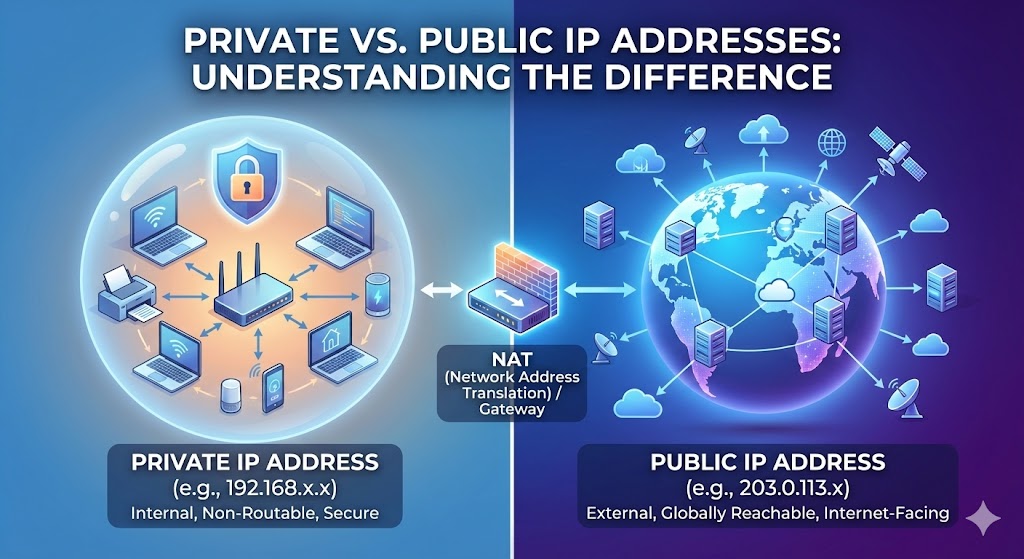
In today’s interconnected digital world, the concept of IP addresses is fundamental to how devices communicate over the internet. Whether you’re browsing the web, sending emails, or streaming your favorite shows, your device relies on an IP address to connect to other devices and servers. But did you know that there are different types of IP addresses, namely private and public? Let’s delve into the basics of private vs. public IP addresses in a language that’s easy to understand.
Table of Contents
IP Addresses in a simple explanation
Before that, let’s clarify what an IP address is. IP stands for Internet Protocol, and an IP address is a unique numerical identifier assigned to each device connected to a network. Think of it as your device’s digital fingerprint, which allows it to be identified and communicate with other devices on the internet.
Private IP Addresses
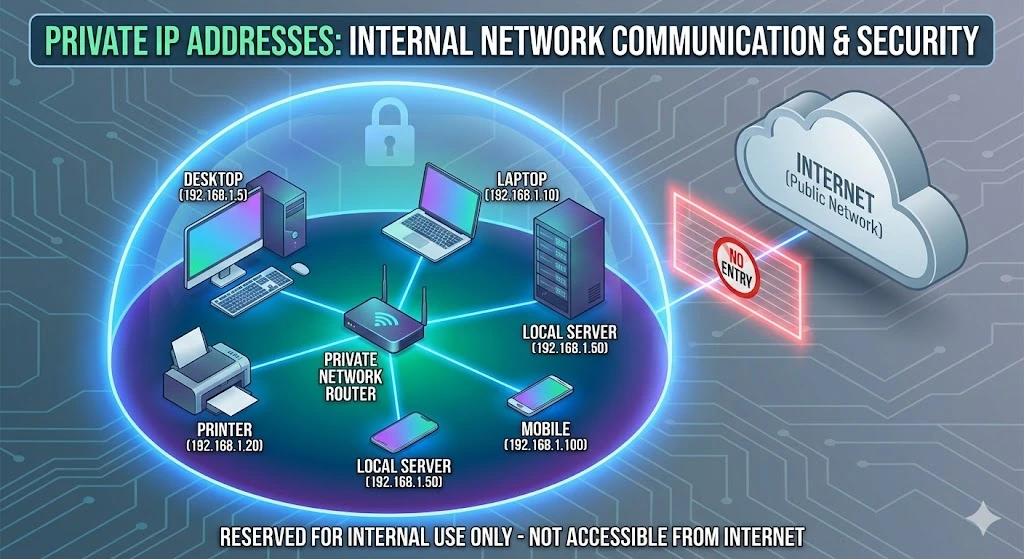
Private IP addresses are used within a private network, such as a home or business network, to identify devices and facilitate communication between them. These addresses are not accessible from the Internet and are reserved for internal use only. The most commonly used private IP address ranges are IPv4 and IPv6.
Private IP addresses enable devices within a network to communicate with each other, access shared resources like printers or servers, and maintain network security by restricting direct access from the internet.
Public IP Addresses
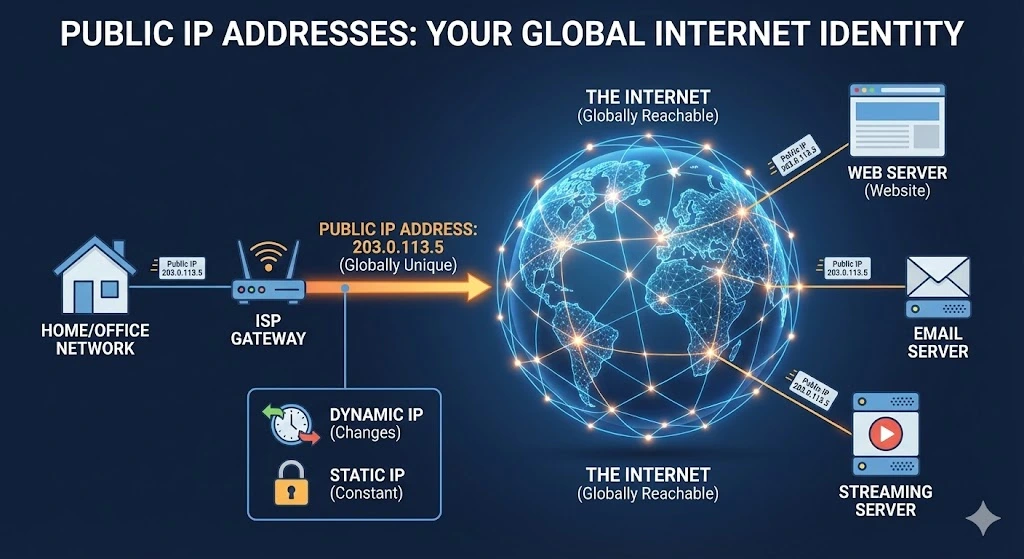
On the other hand, public IP addresses are globally unique addresses assigned to devices connected directly to the internet. These addresses are available across the internet and serve as the interface between a device and the rest of the online world. When you access a website, send an email or stream content, your device uses its public IP address to communicate with servers and other devices on the internet.
Public IP addresses are allocated by Internet Service Providers (ISPs) and are typically dynamic, meaning they can change periodically, or static, meaning they remain constant over time. Businesses, web servers, and other internet-facing devices often use static public IP addresses to ensure consistent accessibility.
Key differences between Public and Private IP addresses
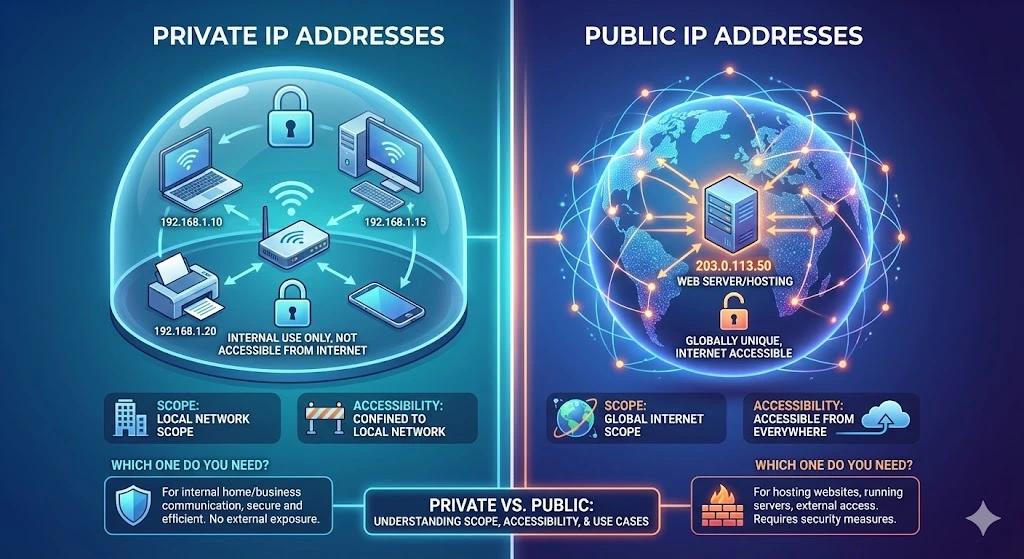
The primary difference between private and public IP addresses lies in their scope and accessibility:
- Scope: Private IP addresses are confined to a local network and are not accessible from the internet. Public IP addresses, on the other hand, are globally unique and enable devices to communicate across the internet.
- Accessibility: Private IP addresses are reserved for internal use within a network and are not directly accessible from the Internet. Public IP addresses are accessible from the internet, allowing devices to send and receive data to and from external networks and servers.
Which one do you need?
The choice between private and public IP addresses depends on your network configuration and requirements.
- Private IP Addresses: If you’re setting up a home or business network for internal use only, private IP addresses are sufficient. They provide a secure and efficient way for devices within the network to communicate without exposing them to external threats.
- Public IP Addresses: If you need your devices to be accessible from the internet, such as for hosting a website or running a server, you’ll need a public IP address. However, keep in mind that public IP addresses may attract security risks, so proper measures such as firewalls and security protocols are essential.
Private and public IP addresses
Private and public IP addresses serve distinct purposes in the realm of networking. Private IP addresses are used within local networks for internal communication, while public IP addresses facilitate communication with external networks and devices over the internet. Understanding the differences between the two types of addresses is crucial for designing and managing effective network infrastructures that meet your connectivity needs while ensuring security and accessibility.
Trusted IPv4 Leasing for Business Growth
Get enterprise-grade IPv4 space quickly, with seamless deployment and end-to-end management.
Get Started with i.leaseFAQs
How do I find my Public IP address?
The easiest way to find your Public IP address is to type “What is my IP” into a search engine like Google. Because your Public IP is assigned by your ISP to your router, every device in your home or office connected to that router will usually show the same Public IP.
Can someone hack me if they have my Public IP address?
Knowing a Public IP address is like knowing a home’s street address—it doesn’t give someone a key to the door, but it tells them where the house is. Hackers can use a Public IP to scan for open ports or unpatched vulnerabilities in your router. This is why using a Firewall and keeping your router’s software updated is essential.
What is NAT (Network Address Translation) and how does it relate to IPs?
NAT is a technology used by your router to act as a “translator.” It allows multiple devices with Private IP addresses in your home to share a single Public IP address to access the internet. This effectively conserves the limited supply of Public IPv4 addresses.
Related Posts
How much does a /24 IPv4 block cost in 2026?
IPv4 scarcity continues to shape internet infrastructure, with /24 blocks still trading actively on global markets despite growing IPv6 adoption. Key points A /24 IPv4 block usually costs between $6,000 and $15,000 in 2026. Cloud providers, hosting companies and SaaS providers need IPv4 addresses so prices stay high. IPv4 addresses are like an asset because they are scarce. What is a /24 IPv4 block A /24 IPv4 blockRead more Related Posts How much does a /24 IPv4 block cost in 2026? IPv4 scarcity continues to shape internet infrastructure, with /24 blocks still trading actively on global markets despite growing IPv6 adoption. Key Read more The future of IPv4 markets Despite IPv6 expansion, scarcity keeps IPv4 valuable, sustaining a global secondary market where addresses increasingly function as tradable digital assets.Finite Read more Common Myths About Selling IP Addresses The IPv4 secondary market is often shrouded in mystery, leading many organizations to sit on valuable digital assets because they Read more .related-post {} .related-post .post-list { text-align: left; } .related-post .post-list .item { margin: 5px; padding: 10px; } .related-post .headline { font-size: 18px !important; color: #999999 !important; } .related-post .post-list .item .post_thumb { max-height: 220px; margin: 10px 0px; padding: 0px; display: block; } .related-post .post-list .item .post_title { font-size: 16px; color: #3f3f3f; margin: 10px 0px; padding: 0px; display: block; text-decoration: none; } .related-post .post-list .item .post_excerpt { font-size: 13px; color: #3f3f3f; margin: 10px 0px; padding: 0px; display: block; text-decoration: none; } @media only screen and (min-width: 1024px) { .related-post .post-list .item { width: 30%; } } @media only screen and (min-width: 768px) and (max-width: 1023px) { .related-post .post-list .item { width: 90%; } } @media only screen and (min-width: 0px) and (max-width: 767px) { .related-post .post-list .item { width: 90%; } }
The future of IPv4 markets
Despite IPv6 expansion, scarcity keeps IPv4 valuable, sustaining a global secondary market where addresses increasingly function as tradable digital assets. Finite IPv4 supply has created a mature secondary market where address blocks are bought, sold and leased worldwide. Prices fluctuate, but persistent demand from cloud, hosting and AI infrastructure suggests IPv4 markets will remain active for years. What happened The rise of a digital commodity The global market forRead more Related Posts How much does a /24 IPv4 block cost in 2026? IPv4 scarcity continues to shape internet infrastructure, with /24 blocks still trading actively on global markets despite growing IPv6 adoption. Key Read more The future of IPv4 markets Despite IPv6 expansion, scarcity keeps IPv4 valuable, sustaining a global secondary market where addresses increasingly function as tradable digital assets.Finite Read more Common Myths About Selling IP Addresses The IPv4 secondary market is often shrouded in mystery, leading many organizations to sit on valuable digital assets because they Read more .related-post {} .related-post .post-list { text-align: left; } .related-post .post-list .item { margin: 5px; padding: 10px; } .related-post .headline { font-size: 18px !important; color: #999999 !important; } .related-post .post-list .item .post_thumb { max-height: 220px; margin: 10px 0px; padding: 0px; display: block; } .related-post .post-list .item .post_title { font-size: 16px; color: #3f3f3f; margin: 10px 0px; padding: 0px; display: block; text-decoration: none; } .related-post .post-list .item .post_excerpt { font-size: 13px; color: #3f3f3f; margin: 10px 0px; padding: 0px; display: block; text-decoration: none; } @media only screen and (min-width: 1024px) { .related-post .post-list .item { width: 30%; } } @media only screen and (min-width: 768px) and (max-width: 1023px) { .related-post .post-list .item { width: 90%; } } @media only screen and (min-width: 0px) and (max-width: 767px) { .related-post .post-list .item { width: 90%; } }
Inbound vs. Outbound IPv4 Leasing: A Complete Guide for Enterprises
Understanding IPv4 leasing helps enterprises manage scarce address space, reducing risk and unlocking strategic growth opportunities in today’s digital economy. Key points Distinguishes between inbound (leasing in) and outbound (leasing out) IPv4 approaches and their strategic implications. Highlights contract structures, registry risk management and continuity considerations affecting global number resources. Inbound vs. outbound IPv4 leasing: complete enterprise guide In the post-exhaustion era of Internet Protocol version 4 (IPv4),Read more Related Posts How much does a /24 IPv4 block cost in 2026? IPv4 scarcity continues to shape internet infrastructure, with /24 blocks still trading actively on global markets despite growing IPv6 adoption. Key Read more The future of IPv4 markets Despite IPv6 expansion, scarcity keeps IPv4 valuable, sustaining a global secondary market where addresses increasingly function as tradable digital assets.Finite Read more Common Myths About Selling IP Addresses The IPv4 secondary market is often shrouded in mystery, leading many organizations to sit on valuable digital assets because they Read more .related-post {} .related-post .post-list { text-align: left; } .related-post .post-list .item { margin: 5px; padding: 10px; } .related-post .headline { font-size: 18px !important; color: #999999 !important; } .related-post .post-list .item .post_thumb { max-height: 220px; margin: 10px 0px; padding: 0px; display: block; } .related-post .post-list .item .post_title { font-size: 16px; color: #3f3f3f; margin: 10px 0px; padding: 0px; display: block; text-decoration: none; } .related-post .post-list .item .post_excerpt { font-size: 13px; color: #3f3f3f; margin: 10px 0px; padding: 0px; display: block; text-decoration: none; } @media only screen and (min-width: 1024px) { .related-post .post-list .item { width: 30%; } } @media only screen and (min-width: 768px) and (max-width: 1023px) { .related-post .post-list .item { width: 90%; } } @media only screen and (min-width: 0px) and (max-width: 767px) { .related-post .post-list .item { width: 90%; } }