LACNIC: All You Need To Know
 Chan
Chan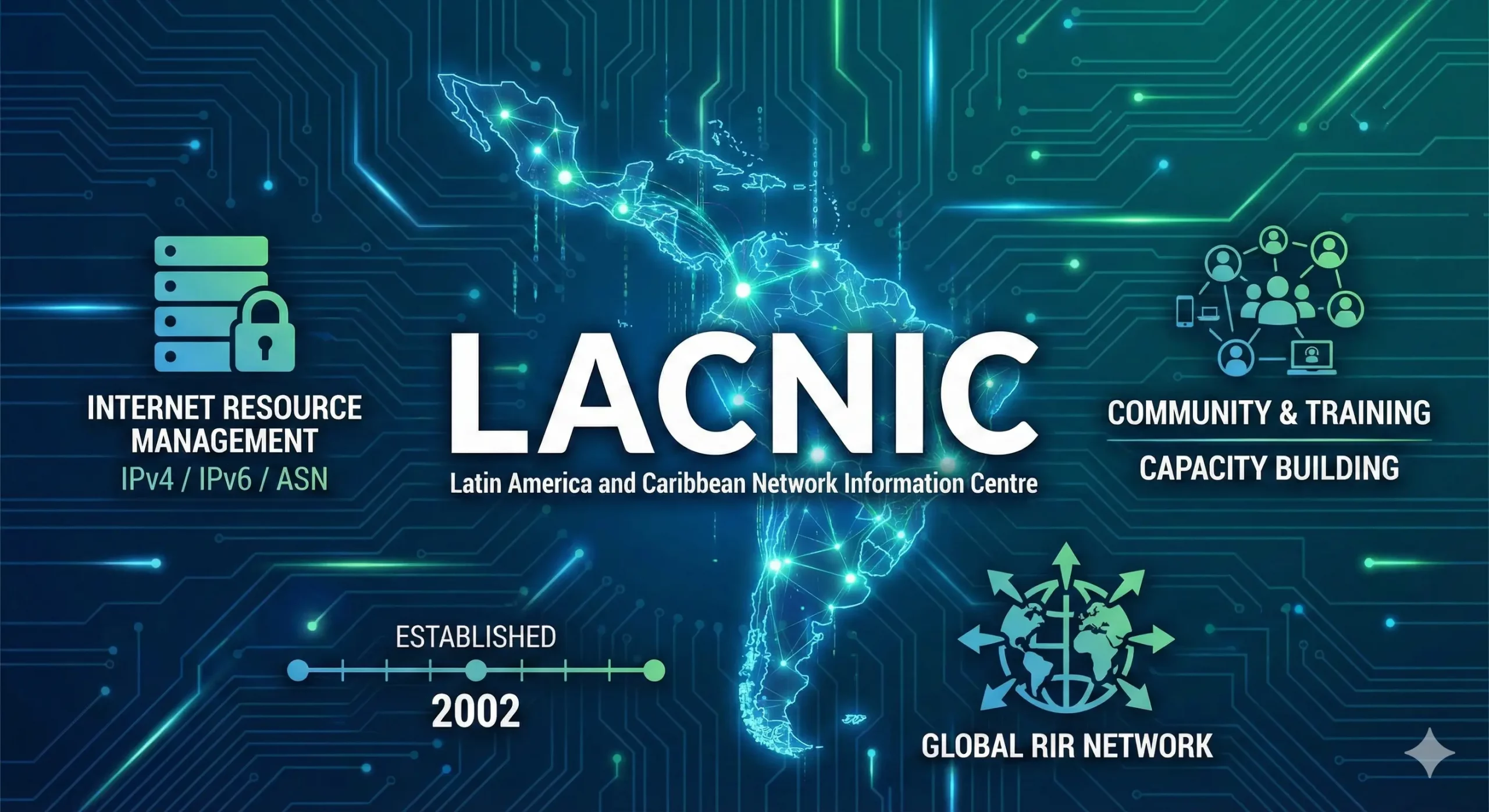
LACNIC: Strengthening Internet Infrastructure in Latin America and the Caribbean
The Latin America and Caribbean Network Information Center (LACNIC) plays a vital role in shaping the digital landscape of Latin America and the Caribbean. As the region’s designated Regional Internet Registry (RIR), LACNIC is responsible for managing and distributing Internet number resources, including IPv4, IPv6 addresses, and Autonomous System Numbers (ASNs).
Table of Contents
Operating as a non-profit community-led organization, LACNIC ensures the fair allocation of resources and actively contributes to Internet development, security, and policy-making in its 33 covered territories. With over 12,000 members, LACNIC fosters collaboration between governments, Internet service providers (ISPs), and the wider digital community to promote a secure and efficient internet ecosystem.
What is LACNIC
LACNIC is one of the five globally recognized Regional Internet Registries (RIRs) that oversee IP address distribution and Internet governance worldwide. The organization operates alongside:
- AFRINIC – Serving the African continent
- APNIC – Managing the Asia-Pacific region
- ARIN – Covering North America and parts of the Caribbean
- RIPE NCC – Serving Europe, the Middle East, and parts of Central Asia
Since its establishment in 2002, LACNIC has played a pivotal role in ensuring the efficient allocation of Internet number resources in Latin America and the Caribbean. The organization receives these resources from the Internet Assigned Numbers Authority (IANA) and redistributes them according to regional demand and policies.
Beyond resource management, LACNIC is committed to enhancing Internet accessibility, security, and governance, providing its members with technical training, cybersecurity solutions, and active participation in shaping global Internet policies.
Membership and Governance Model
LACNIC stands out for its community-driven governance approach. The organization is overseen by a board of seven directors, elected directly by its members. This democratic model ensures that decision-making aligns with the needs and priorities of the regional internet community.
Membership provides several key benefits beyond IP address allocation, including:
- Influence in Policy Development: Members can participate in shaping regional internet governance policies.
- Technical Training via LACNIC Campus: Online and in-person courses on network management, security, and IPv6 adoption.
- Cybersecurity Support from LACNIC CSIRT: A dedicated team that assists in preventing cyber threats and securing regional internet operations.
- Representation in Global Internet Governance Forums: LACNIC advocates for regional interests on the global stage.
- Collaboration with Internet Exchange Points (IXPs) and Tech Providers: Helping members optimize network performance and resource management.
Key Functions and Services Provided by LACNIC
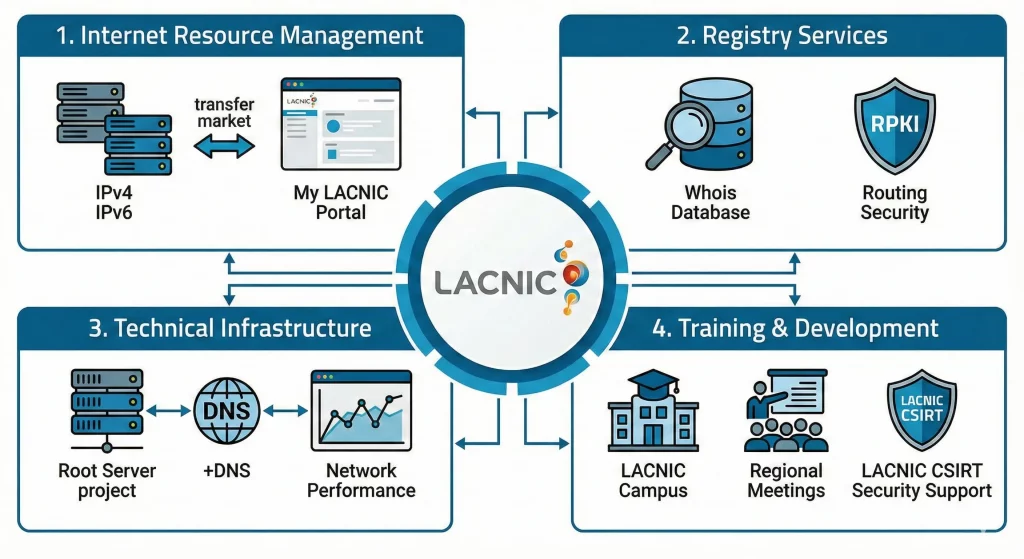
LACNIC’s core mission is to strengthen and support Internet infrastructure across Latin America and the Caribbean. To achieve this, the organization provides a range of technical and strategic services, ensuring stability, security, and growth.
1. Internet Resource management
LACNIC oversees the allocation of IPv4 and IPv6 addresses and ASNs across Latin America and the Caribbean. The organization maintains a transfer market for IPv4 resources and promotes IPv6 adoption through streamlined allocation processes. Through its My LACNIC portal, members can manage their resources and handle administrative tasks efficiently.
2. Registry services
The LACNIC Whois database serves as the authoritative registry for IP allocations in the region. The database helps identify resource ownership, supports abuse prevention, and maintains transparency in resource distribution. LACNIC’s RPKI services enhance routing security by validating resource ownership and preventing unauthorized announcements.
3. Technical infrastructure
LACNIC provides essential DNS services, including Reverse DNS Management and the +RAICES project, which maintains root server copies to improve regional internet stability. The Internet Routing Registry helps operators manage routing policies, while monitoring tools track network performance and security across the region.
4. Training and development
LACNIC Campus provides training on IPv6, security, and network management. It hosts regional meetings for knowledge sharing and policy discussions. Through LACNIC CSIRT, members get security support and best practices guidance.
Trusted IPv4 Leasing for Business Growth
Get enterprise-grade IPv4 space quickly, with seamless deployment and end-to-end management.
Get Started with i.leaseRelated Posts
How much does a /24 IPv4 block cost in 2026?
IPv4 scarcity continues to shape internet infrastructure, with /24 blocks still trading actively on global markets despite growing IPv6 adoption. Key points A /24 IPv4 block usually costs between $6,000 and $15,000 in 2026. Cloud providers, hosting companies and SaaS providers need IPv4 addresses so prices stay high. IPv4 addresses are like an asset because they are scarce. What is a /24 IPv4 block A /24 IPv4 blockRead more Related Posts How much does a /24 IPv4 block cost in 2026? IPv4 scarcity continues to shape internet infrastructure, with /24 blocks still trading actively on global markets despite growing IPv6 adoption. Key Read more The future of IPv4 markets Despite IPv6 expansion, scarcity keeps IPv4 valuable, sustaining a global secondary market where addresses increasingly function as tradable digital assets.Finite Read more Common Myths About Selling IP Addresses The IPv4 secondary market is often shrouded in mystery, leading many organizations to sit on valuable digital assets because they Read more .related-post {} .related-post .post-list { text-align: left; } .related-post .post-list .item { margin: 5px; padding: 10px; } .related-post .headline { font-size: 18px !important; color: #999999 !important; } .related-post .post-list .item .post_thumb { max-height: 220px; margin: 10px 0px; padding: 0px; display: block; } .related-post .post-list .item .post_title { font-size: 16px; color: #3f3f3f; margin: 10px 0px; padding: 0px; display: block; text-decoration: none; } .related-post .post-list .item .post_excerpt { font-size: 13px; color: #3f3f3f; margin: 10px 0px; padding: 0px; display: block; text-decoration: none; } @media only screen and (min-width: 1024px) { .related-post .post-list .item { width: 30%; } } @media only screen and (min-width: 768px) and (max-width: 1023px) { .related-post .post-list .item { width: 90%; } } @media only screen and (min-width: 0px) and (max-width: 767px) { .related-post .post-list .item { width: 90%; } }
The future of IPv4 markets
Despite IPv6 expansion, scarcity keeps IPv4 valuable, sustaining a global secondary market where addresses increasingly function as tradable digital assets. Finite IPv4 supply has created a mature secondary market where address blocks are bought, sold and leased worldwide. Prices fluctuate, but persistent demand from cloud, hosting and AI infrastructure suggests IPv4 markets will remain active for years. What happened The rise of a digital commodity The global market forRead more Related Posts How much does a /24 IPv4 block cost in 2026? IPv4 scarcity continues to shape internet infrastructure, with /24 blocks still trading actively on global markets despite growing IPv6 adoption. Key Read more The future of IPv4 markets Despite IPv6 expansion, scarcity keeps IPv4 valuable, sustaining a global secondary market where addresses increasingly function as tradable digital assets.Finite Read more Common Myths About Selling IP Addresses The IPv4 secondary market is often shrouded in mystery, leading many organizations to sit on valuable digital assets because they Read more .related-post {} .related-post .post-list { text-align: left; } .related-post .post-list .item { margin: 5px; padding: 10px; } .related-post .headline { font-size: 18px !important; color: #999999 !important; } .related-post .post-list .item .post_thumb { max-height: 220px; margin: 10px 0px; padding: 0px; display: block; } .related-post .post-list .item .post_title { font-size: 16px; color: #3f3f3f; margin: 10px 0px; padding: 0px; display: block; text-decoration: none; } .related-post .post-list .item .post_excerpt { font-size: 13px; color: #3f3f3f; margin: 10px 0px; padding: 0px; display: block; text-decoration: none; } @media only screen and (min-width: 1024px) { .related-post .post-list .item { width: 30%; } } @media only screen and (min-width: 768px) and (max-width: 1023px) { .related-post .post-list .item { width: 90%; } } @media only screen and (min-width: 0px) and (max-width: 767px) { .related-post .post-list .item { width: 90%; } }
Inbound vs. Outbound IPv4 Leasing: A Complete Guide for Enterprises
Understanding IPv4 leasing helps enterprises manage scarce address space, reducing risk and unlocking strategic growth opportunities in today’s digital economy. Key points Distinguishes between inbound (leasing in) and outbound (leasing out) IPv4 approaches and their strategic implications. Highlights contract structures, registry risk management and continuity considerations affecting global number resources. Inbound vs. outbound IPv4 leasing: complete enterprise guide In the post-exhaustion era of Internet Protocol version 4 (IPv4),Read more Related Posts How much does a /24 IPv4 block cost in 2026? IPv4 scarcity continues to shape internet infrastructure, with /24 blocks still trading actively on global markets despite growing IPv6 adoption. Key Read more The future of IPv4 markets Despite IPv6 expansion, scarcity keeps IPv4 valuable, sustaining a global secondary market where addresses increasingly function as tradable digital assets.Finite Read more Common Myths About Selling IP Addresses The IPv4 secondary market is often shrouded in mystery, leading many organizations to sit on valuable digital assets because they Read more .related-post {} .related-post .post-list { text-align: left; } .related-post .post-list .item { margin: 5px; padding: 10px; } .related-post .headline { font-size: 18px !important; color: #999999 !important; } .related-post .post-list .item .post_thumb { max-height: 220px; margin: 10px 0px; padding: 0px; display: block; } .related-post .post-list .item .post_title { font-size: 16px; color: #3f3f3f; margin: 10px 0px; padding: 0px; display: block; text-decoration: none; } .related-post .post-list .item .post_excerpt { font-size: 13px; color: #3f3f3f; margin: 10px 0px; padding: 0px; display: block; text-decoration: none; } @media only screen and (min-width: 1024px) { .related-post .post-list .item { width: 30%; } } @media only screen and (min-width: 768px) and (max-width: 1023px) { .related-post .post-list .item { width: 90%; } } @media only screen and (min-width: 0px) and (max-width: 767px) { .related-post .post-list .item { width: 90%; } }