IP Solutions: Enhancing Connectivity and Business Efficiency
 Chan
Chan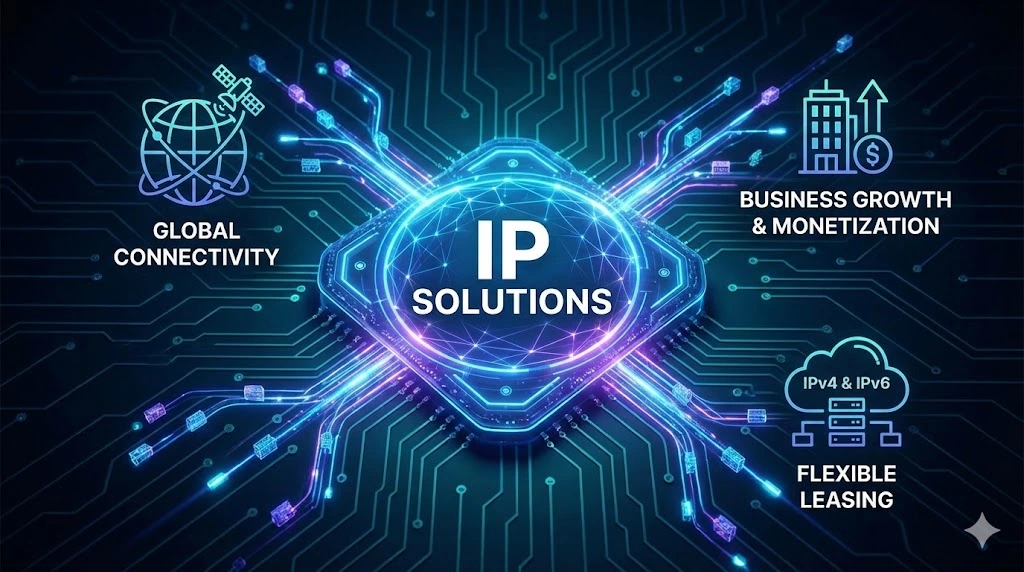
The Internet underpins most business operations, and hence, managing IP (Internet Protocol) resources effectively is crucial. IP solutions involve a range of services and technologies designed to optimize the management and use of IP addresses, which are essential for devices to communicate over the Internet.
Table of Contents
This article delves into what IP solutions are, their benefits, and why they are critical for businesses looking to thrive in a connected world.
Understanding IP Solutions
IP solutions refer to the strategies and technologies used to manage and allocate IP addresses within a network. As the number of internet-enabled devices continues to rise, organizations face significant challenges in tracking, organizing, and securing their IP address resources. Effective IP solutions help businesses overcome these challenges by ensuring that IP addresses are managed efficiently, securely, and in compliance with relevant regulations.
Key Components of IP Solutions
IP Address Management (IPAM)
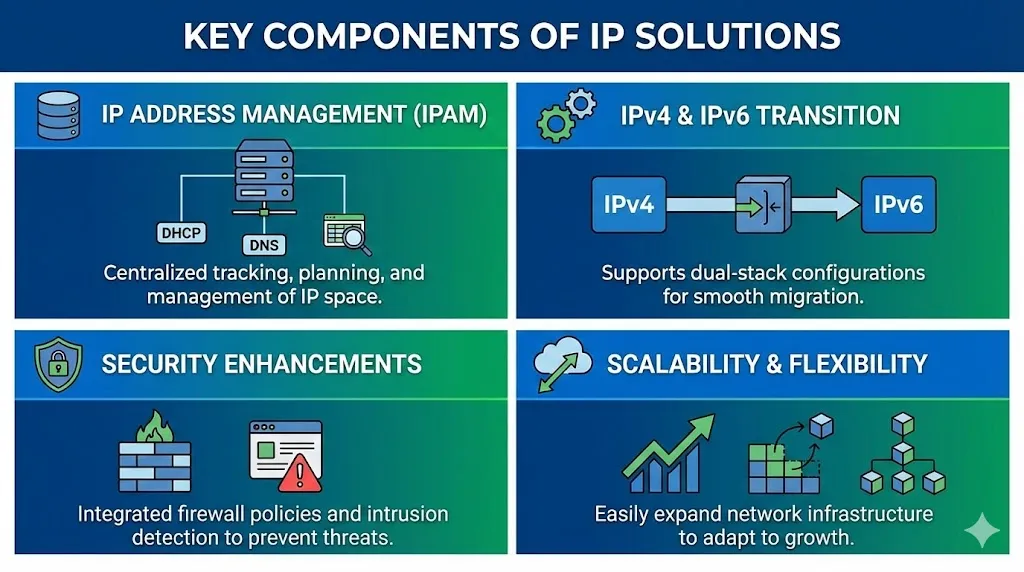
IPAM systems are crucial for managing an organization’s IP address space. They provide a centralized database where network administrators can track, plan, and manage the network’s IP addresses. This management includes handling DHCP (Dynamic Host Configuration Protocol) and DNS (Domain Name System) data, which are critical for network operation.
IPv4 and IPv6 Transition
With the depletion of IPv4 addresses, transitioning to IPv6 has become a necessity for many businesses. IP solutions facilitate this transition by supporting dual-stack configurations, enabling organizations to run IPv4 and IPv6 concurrently and smoothly transition between the two.
Security Enhancements
IP solutions include features that enhance network security, such as integrated firewall policies and intrusion detection systems. By controlling IP allocation and monitoring network traffic, businesses can better prevent unauthorized access and potential cyber threats.
Scalability and Flexibility
Advanced IP solutions offer scalability, allowing businesses to expand their network as they grow. This flexibility is crucial in today’s dynamic business environment, where companies must quickly adapt to changes in demand and technology.
Benefits of IP Solutions
Improved Network Efficiency
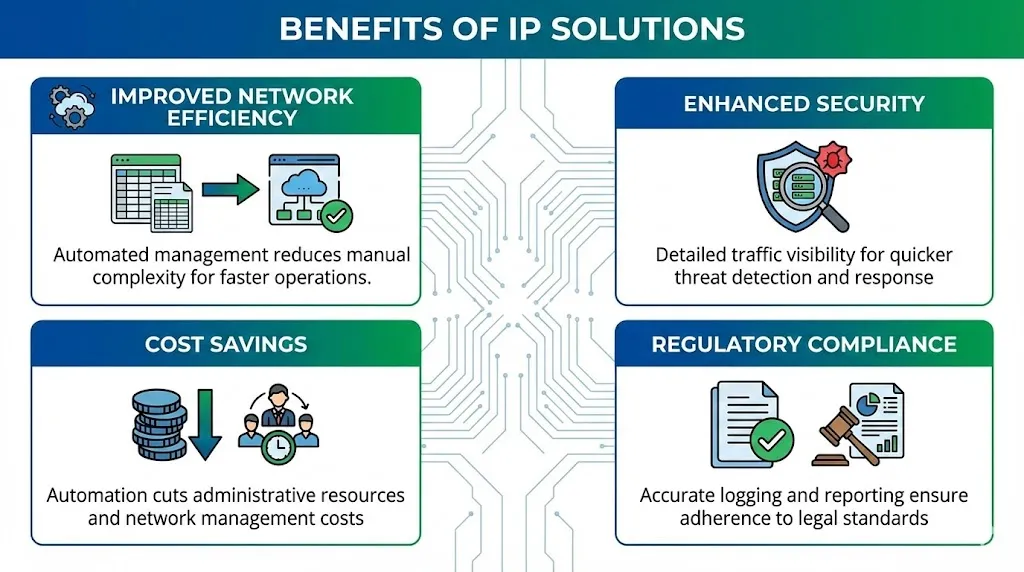
By automating IP address management, businesses can reduce the complexities associated with manual tracking and allocation, leading to more efficient network operations.
Enhanced Security
Effective IP solutions help secure a network by providing detailed visibility into IP traffic, which aids in detecting and responding to security threats.
Cost Savings
Automating IP management reduces the need for extensive administrative resources, thereby cutting costs associated with network management.
Regulatory Compliance
With strict regulations around data transmission and privacy, IP solutions help businesses comply with legal standards by providing accurate logs and reports of IP address usage.
Real-World Applications
IP solutions are used across various industries, from telecommunications and IT services to healthcare and finance. For instance, in the telecommunications sector, IP solutions are essential for managing the vast number of IP addresses required for customer devices and infrastructure. In healthcare, securing IP addresses is critical for protecting sensitive patient information transmitted across networks.
As the backbone of internet connectivity, IP management is more critical than ever. With the right IP solutions, businesses can enhance their network efficiency, bolster security, and ensure continuous compliance with regulatory standards. As technology continues to evolve, investing in robust IP solutions will remain a key strategy for businesses aiming to capitalize on the opportunities of a hyper-connected world.
Trusted IPv4 Leasing for Business Growth
Get enterprise-grade IPv4 space quickly, with seamless deployment and end-to-end management.
Get Started with i.leaseFAQs
What is the difference between IP Solutions and standard hosting?
Standard hosting provides server space for your website, while IP Solutions focus on the management, allocation, and routing of the IP addresses themselves. This includes services like IP leasing, IPAM (IP Address Management) software, and optimizing how your IP blocks are routed globally for better performance and security.
How can IP Solutions help with the IPv4 shortage?
Since buying new IPv4 addresses is expensive and difficult due to exhaustion, IP Solutions providers (like i.lease) offer IPv4 Leasing and IP Brokerage. This allows businesses to rent the exact number of IPs they need instantly without the massive capital expenditure of purchasing them on the open market.
Do I need an IPAM (IP Address Management) tool?
If you manage more than a few hundred IP addresses, yes. Using spreadsheets to track IPs leads to errors like “IP conflicts” (two devices assigned the same IP). An automated IPAM tool tracks usage in real-time, detects conflicts, and helps you reclaim unused addresses to save money.
Related Posts
How much does a /24 IPv4 block cost in 2026?
IPv4 scarcity continues to shape internet infrastructure, with /24 blocks still trading actively on global markets despite growing IPv6 adoption. Key points A /24 IPv4 block usually costs between $6,000 and $15,000 in 2026. Cloud providers, hosting companies and SaaS providers need IPv4 addresses so prices stay high. IPv4 addresses are like an asset because they are scarce. What is a /24 IPv4 block A /24 IPv4 blockRead more Related Posts How much does a /24 IPv4 block cost in 2026? IPv4 scarcity continues to shape internet infrastructure, with /24 blocks still trading actively on global markets despite growing IPv6 adoption. Key Read more The future of IPv4 markets Despite IPv6 expansion, scarcity keeps IPv4 valuable, sustaining a global secondary market where addresses increasingly function as tradable digital assets.Finite Read more Common Myths About Selling IP Addresses The IPv4 secondary market is often shrouded in mystery, leading many organizations to sit on valuable digital assets because they Read more .related-post {} .related-post .post-list { text-align: left; } .related-post .post-list .item { margin: 5px; padding: 10px; } .related-post .headline { font-size: 18px !important; color: #999999 !important; } .related-post .post-list .item .post_thumb { max-height: 220px; margin: 10px 0px; padding: 0px; display: block; } .related-post .post-list .item .post_title { font-size: 16px; color: #3f3f3f; margin: 10px 0px; padding: 0px; display: block; text-decoration: none; } .related-post .post-list .item .post_excerpt { font-size: 13px; color: #3f3f3f; margin: 10px 0px; padding: 0px; display: block; text-decoration: none; } @media only screen and (min-width: 1024px) { .related-post .post-list .item { width: 30%; } } @media only screen and (min-width: 768px) and (max-width: 1023px) { .related-post .post-list .item { width: 90%; } } @media only screen and (min-width: 0px) and (max-width: 767px) { .related-post .post-list .item { width: 90%; } }
The future of IPv4 markets
Despite IPv6 expansion, scarcity keeps IPv4 valuable, sustaining a global secondary market where addresses increasingly function as tradable digital assets. Finite IPv4 supply has created a mature secondary market where address blocks are bought, sold and leased worldwide. Prices fluctuate, but persistent demand from cloud, hosting and AI infrastructure suggests IPv4 markets will remain active for years. What happened The rise of a digital commodity The global market forRead more Related Posts How much does a /24 IPv4 block cost in 2026? IPv4 scarcity continues to shape internet infrastructure, with /24 blocks still trading actively on global markets despite growing IPv6 adoption. Key Read more The future of IPv4 markets Despite IPv6 expansion, scarcity keeps IPv4 valuable, sustaining a global secondary market where addresses increasingly function as tradable digital assets.Finite Read more Common Myths About Selling IP Addresses The IPv4 secondary market is often shrouded in mystery, leading many organizations to sit on valuable digital assets because they Read more .related-post {} .related-post .post-list { text-align: left; } .related-post .post-list .item { margin: 5px; padding: 10px; } .related-post .headline { font-size: 18px !important; color: #999999 !important; } .related-post .post-list .item .post_thumb { max-height: 220px; margin: 10px 0px; padding: 0px; display: block; } .related-post .post-list .item .post_title { font-size: 16px; color: #3f3f3f; margin: 10px 0px; padding: 0px; display: block; text-decoration: none; } .related-post .post-list .item .post_excerpt { font-size: 13px; color: #3f3f3f; margin: 10px 0px; padding: 0px; display: block; text-decoration: none; } @media only screen and (min-width: 1024px) { .related-post .post-list .item { width: 30%; } } @media only screen and (min-width: 768px) and (max-width: 1023px) { .related-post .post-list .item { width: 90%; } } @media only screen and (min-width: 0px) and (max-width: 767px) { .related-post .post-list .item { width: 90%; } }
Inbound vs. Outbound IPv4 Leasing: A Complete Guide for Enterprises
Understanding IPv4 leasing helps enterprises manage scarce address space, reducing risk and unlocking strategic growth opportunities in today’s digital economy. Key points Distinguishes between inbound (leasing in) and outbound (leasing out) IPv4 approaches and their strategic implications. Highlights contract structures, registry risk management and continuity considerations affecting global number resources. Inbound vs. outbound IPv4 leasing: complete enterprise guide In the post-exhaustion era of Internet Protocol version 4 (IPv4),Read more Related Posts How much does a /24 IPv4 block cost in 2026? IPv4 scarcity continues to shape internet infrastructure, with /24 blocks still trading actively on global markets despite growing IPv6 adoption. Key Read more The future of IPv4 markets Despite IPv6 expansion, scarcity keeps IPv4 valuable, sustaining a global secondary market where addresses increasingly function as tradable digital assets.Finite Read more Common Myths About Selling IP Addresses The IPv4 secondary market is often shrouded in mystery, leading many organizations to sit on valuable digital assets because they Read more .related-post {} .related-post .post-list { text-align: left; } .related-post .post-list .item { margin: 5px; padding: 10px; } .related-post .headline { font-size: 18px !important; color: #999999 !important; } .related-post .post-list .item .post_thumb { max-height: 220px; margin: 10px 0px; padding: 0px; display: block; } .related-post .post-list .item .post_title { font-size: 16px; color: #3f3f3f; margin: 10px 0px; padding: 0px; display: block; text-decoration: none; } .related-post .post-list .item .post_excerpt { font-size: 13px; color: #3f3f3f; margin: 10px 0px; padding: 0px; display: block; text-decoration: none; } @media only screen and (min-width: 1024px) { .related-post .post-list .item { width: 30%; } } @media only screen and (min-width: 768px) and (max-width: 1023px) { .related-post .post-list .item { width: 90%; } } @media only screen and (min-width: 0px) and (max-width: 767px) { .related-post .post-list .item { width: 90%; } }