IP Address Marketplace Comprehensive Guide
 Chan
Chan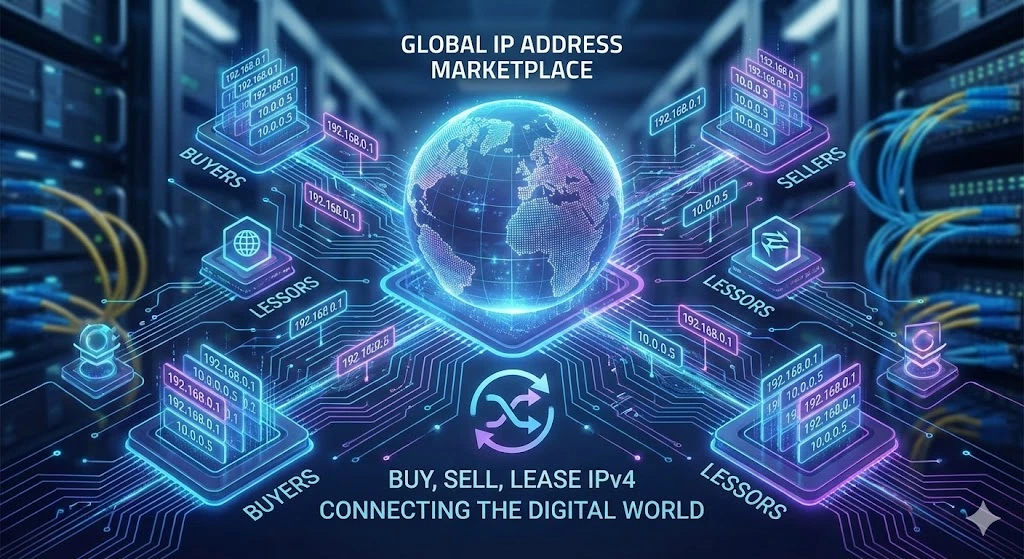
IP addresses are crucial for identifying devices and enabling communication across networks. As the internet continues to expand, the demand for IP addresses has surged, leading to the rise of the IP address marketplace. This unique market allows businesses and individuals to buy, sell, or lease IP addresses, ensuring that resources are optimally utilized in a world where IPv4 addresses are becoming scarce.
Table of Contents
What Is an IP Address Marketplace?
An IP address marketplace is a platform where organizations and individuals can trade IP address blocks. This marketplace has emerged due to the limited availability of IPv4 addresses. The exhaustion of these addresses has created a supply-demand imbalance, making them valuable digital assets. The marketplace facilitates the transfer of unused or underutilized IPv4 addresses from companies that no longer need them to those that do.
Why Do IP Address Marketplaces Exist?
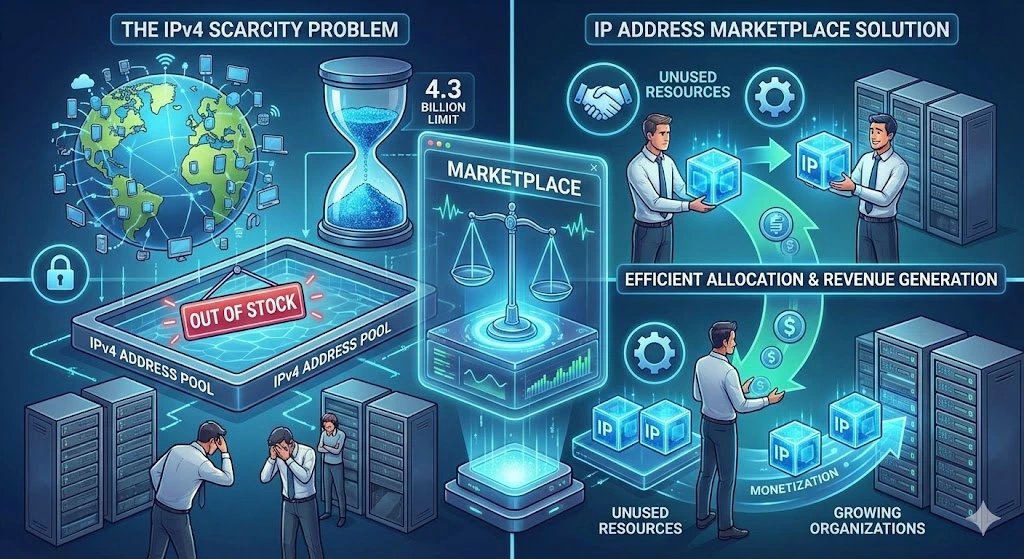
The IP address marketplace was born out of necessity when IPv4 addresses, limited to approximately 4.3 billion unique addresses, began running out. As more devices connected to the Internet, organizations found it increasingly difficult to obtain new addresses. Meanwhile, some entities held large blocks of unused IP addresses, creating an opportunity for monetization.
This market solves several challenges:
1. Scarcity of IPv4 addresses: With only a finite number of IPv4 addresses, many organizations need to purchase blocks for their operations.
2. Efficient use of resources: IP address marketplaces promote the efficient allocation of addresses by allowing businesses to sell or lease unused IP addresses.
3. Monetization: Companies that own unused IP addresses can generate revenue by selling or leasing them.
How Does an IP Address Marketplace Work?
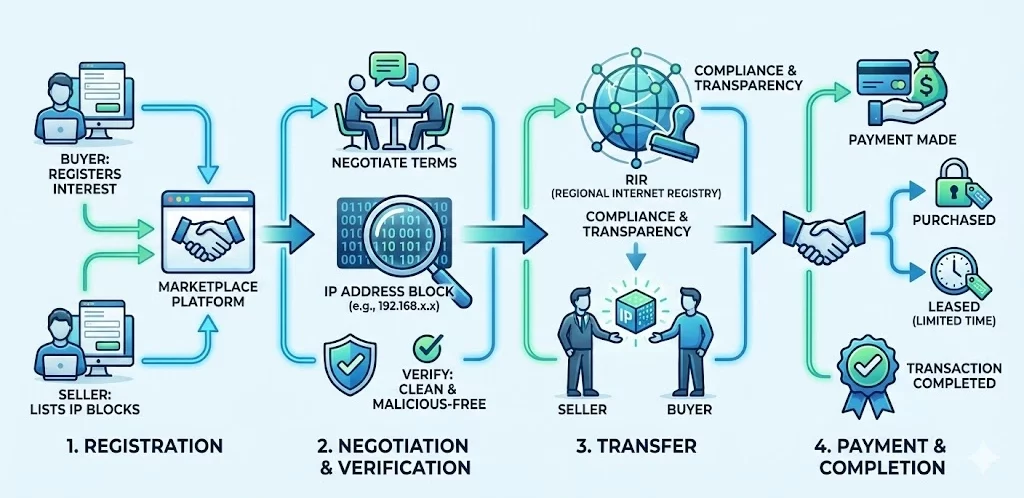
In an IP address marketplace, buyers and sellers engage in transactions to trade blocks of IP addresses, typically under the supervision of an IP address broker or through a specialized platform. Here’s a simplified breakdown of how the marketplace works:
Registration: Both buyers and sellers must register on the marketplace platform. Sellers list available IP address blocks, while buyers express their interest in acquiring them.
Negotiation and Verification: Once a buyer is interested, they negotiate with the seller. The marketplace or a third-party broker often verifies the IP addresses, ensuring they are clean and have no associated malicious activities.
Transfer: After an agreement is reached, the seller transfers the ownership of the IP addresses to the buyer. The transaction is usually carried out through the Regional Internet Registry (RIR) for transparency and compliance.
Payment and Completion: The buyer makes the payment, and the transaction is completed. Some marketplaces offer leasing options, allowing buyers to use the IP addresses for a limited time instead of purchasing them outright.
IP Address Marketplaces
As the Internet continues to grow and IPv4 addresses become even scarcer, the IP address marketplace will play an increasingly critical role in the digital ecosystem. The rise of IPv6—the next-generation IP address protocol—will eventually mitigate the shortage, but the transition is slow, and IPv4 will continue to be relevant for many years to come.
In the meantime, IP address marketplaces will thrive, facilitating the exchange of these valuable digital assets. Companies and individuals seeking to expand their digital infrastructure or monetize their unused IP blocks will continue to turn to these marketplaces for solutions.
Trusted IPv4 Leasing for Business Growth
Get enterprise-grade IPv4 space quickly, with seamless deployment and end-to-end management.
Get Started with i.leaseRelated Posts
How much does a /24 IPv4 block cost in 2026?
IPv4 scarcity continues to shape internet infrastructure, with /24 blocks still trading actively on global markets despite growing IPv6 adoption. Key points A /24 IPv4 block usually costs between $6,000 and $15,000 in 2026. Cloud providers, hosting companies and SaaS providers need IPv4 addresses so prices stay high. IPv4 addresses are like an asset because they are scarce. What is a /24 IPv4 block A /24 IPv4 blockRead more Related Posts How much does a /24 IPv4 block cost in 2026? IPv4 scarcity continues to shape internet infrastructure, with /24 blocks still trading actively on global markets despite growing IPv6 adoption. Key Read more The future of IPv4 markets Despite IPv6 expansion, scarcity keeps IPv4 valuable, sustaining a global secondary market where addresses increasingly function as tradable digital assets.Finite Read more Common Myths About Selling IP Addresses The IPv4 secondary market is often shrouded in mystery, leading many organizations to sit on valuable digital assets because they Read more .related-post {} .related-post .post-list { text-align: left; } .related-post .post-list .item { margin: 5px; padding: 10px; } .related-post .headline { font-size: 18px !important; color: #999999 !important; } .related-post .post-list .item .post_thumb { max-height: 220px; margin: 10px 0px; padding: 0px; display: block; } .related-post .post-list .item .post_title { font-size: 16px; color: #3f3f3f; margin: 10px 0px; padding: 0px; display: block; text-decoration: none; } .related-post .post-list .item .post_excerpt { font-size: 13px; color: #3f3f3f; margin: 10px 0px; padding: 0px; display: block; text-decoration: none; } @media only screen and (min-width: 1024px) { .related-post .post-list .item { width: 30%; } } @media only screen and (min-width: 768px) and (max-width: 1023px) { .related-post .post-list .item { width: 90%; } } @media only screen and (min-width: 0px) and (max-width: 767px) { .related-post .post-list .item { width: 90%; } }
The future of IPv4 markets
Despite IPv6 expansion, scarcity keeps IPv4 valuable, sustaining a global secondary market where addresses increasingly function as tradable digital assets. Finite IPv4 supply has created a mature secondary market where address blocks are bought, sold and leased worldwide. Prices fluctuate, but persistent demand from cloud, hosting and AI infrastructure suggests IPv4 markets will remain active for years. What happened The rise of a digital commodity The global market forRead more Related Posts How much does a /24 IPv4 block cost in 2026? IPv4 scarcity continues to shape internet infrastructure, with /24 blocks still trading actively on global markets despite growing IPv6 adoption. Key Read more The future of IPv4 markets Despite IPv6 expansion, scarcity keeps IPv4 valuable, sustaining a global secondary market where addresses increasingly function as tradable digital assets.Finite Read more Common Myths About Selling IP Addresses The IPv4 secondary market is often shrouded in mystery, leading many organizations to sit on valuable digital assets because they Read more .related-post {} .related-post .post-list { text-align: left; } .related-post .post-list .item { margin: 5px; padding: 10px; } .related-post .headline { font-size: 18px !important; color: #999999 !important; } .related-post .post-list .item .post_thumb { max-height: 220px; margin: 10px 0px; padding: 0px; display: block; } .related-post .post-list .item .post_title { font-size: 16px; color: #3f3f3f; margin: 10px 0px; padding: 0px; display: block; text-decoration: none; } .related-post .post-list .item .post_excerpt { font-size: 13px; color: #3f3f3f; margin: 10px 0px; padding: 0px; display: block; text-decoration: none; } @media only screen and (min-width: 1024px) { .related-post .post-list .item { width: 30%; } } @media only screen and (min-width: 768px) and (max-width: 1023px) { .related-post .post-list .item { width: 90%; } } @media only screen and (min-width: 0px) and (max-width: 767px) { .related-post .post-list .item { width: 90%; } }
Inbound vs. Outbound IPv4 Leasing: A Complete Guide for Enterprises
Understanding IPv4 leasing helps enterprises manage scarce address space, reducing risk and unlocking strategic growth opportunities in today’s digital economy. Key points Distinguishes between inbound (leasing in) and outbound (leasing out) IPv4 approaches and their strategic implications. Highlights contract structures, registry risk management and continuity considerations affecting global number resources. Inbound vs. outbound IPv4 leasing: complete enterprise guide In the post-exhaustion era of Internet Protocol version 4 (IPv4),Read more Related Posts How much does a /24 IPv4 block cost in 2026? IPv4 scarcity continues to shape internet infrastructure, with /24 blocks still trading actively on global markets despite growing IPv6 adoption. Key Read more The future of IPv4 markets Despite IPv6 expansion, scarcity keeps IPv4 valuable, sustaining a global secondary market where addresses increasingly function as tradable digital assets.Finite Read more Common Myths About Selling IP Addresses The IPv4 secondary market is often shrouded in mystery, leading many organizations to sit on valuable digital assets because they Read more .related-post {} .related-post .post-list { text-align: left; } .related-post .post-list .item { margin: 5px; padding: 10px; } .related-post .headline { font-size: 18px !important; color: #999999 !important; } .related-post .post-list .item .post_thumb { max-height: 220px; margin: 10px 0px; padding: 0px; display: block; } .related-post .post-list .item .post_title { font-size: 16px; color: #3f3f3f; margin: 10px 0px; padding: 0px; display: block; text-decoration: none; } .related-post .post-list .item .post_excerpt { font-size: 13px; color: #3f3f3f; margin: 10px 0px; padding: 0px; display: block; text-decoration: none; } @media only screen and (min-width: 1024px) { .related-post .post-list .item { width: 30%; } } @media only screen and (min-width: 768px) and (max-width: 1023px) { .related-post .post-list .item { width: 90%; } } @media only screen and (min-width: 0px) and (max-width: 767px) { .related-post .post-list .item { width: 90%; } }