How to evaluate an IP broker’s track record
 Stephanie
1. Understand the role of an IP address broker
Table of Contents
An IP address broker acts as the main intermediary between IP holders and potential buyers, lessees, or investors. Their role is to connect organizations that need IPv4 or IPv6 addresses with those that have unused resources, ensuring a smooth and compliant transfer.
Their role includes:
Their responsibilities include:
2. Assess experience and reputation
Experience is one of the most reliable indicators of a broker’s trustworthiness. Brokers with years of completed IP address transactions have stronger networks, deeper market knowledge, and the ability to handle unexpected challenges.
- Check how long they’ve been in the market.
- Verify whether they have completed transfers in the same RIR region as your need (ARIN, RIPE NCC, APNIC, AFRINIC, or LACNIC).
- Review client testimonials, case studies, and independent feedback to gauge reputation.
3. Compliance assurance: Core competence of IP brokers
A broker must have strong knowledge of RIR policies and regulatory requirements.
For example:
- ARIN (North America) has strict requirements for ownership transfers.
- RIPE NCC (Europe, Middle East, Central Asia) requires documented justification and technical reviews.
- APNIC, AFRINIC, and LACNIC each have specific documentation and transfer rules.
Professional brokers:
- Prepare all required forms and documents in advance.
- Maintain communication with registries.
- Anticipate issues like mismatched records or technical inconsistencies and resolve them quickly to avoid delays.
4. Evaluate financial stability and transparency
4.1 Financial stability
A broker with stable finances is more reliable. If a firm is struggling with cash flow, your transaction could face delays or risks. You can:
- Request references from previous clients.
- Review public filings (if available).
- Ask industry contacts about the broker’s reliability.
4.2 Transparency
Trustworthy brokers explain upfront:
- Their fee structure and payment schedule.
- The transaction process, expected timelines, and possible risks.
Clear communication builds confidence and prevents surprises later.
5. Analyse past success and case studies
A broker’s past work shows more than their marketing claims. Review:
- Portfolio of completed transactions – consistent success across market cycles shows resilience.
- Case studies – how they solved real-world challenges.
- References – direct feedback from past clients about responsiveness and results.
- Success rate – percentage of deals completed versus abandoned, which reflects negotiation skill and market reach.
6. Consider post-transaction support and future opportunities
Reliable brokers support clients even after a transfer is complete, including:
- Ensuring RIR records are updated correctly.
- Providing guidance on compliance and dispute resolution.
- Advising on leasing, reselling, or expansion opportunities in the future.
A strong relationship with your broker can bring long-term value as IP address market conditions evolve.
Trusted IPv4 Leasing for Business Growth
Get enterprise-grade IPv4 space quickly, with seamless deployment and end-to-end management.
Get Started with i.leaseFAQs
What is an IP address broker?
An IP address broker helps organizations buy, sell, or lease IPv4 and IPv6 address blocks while ensuring regulatory compliance.
How do I check if a broker has experience in my region?
Ask for case studies and references from clients in the same RIR (ARIN, RIPE, APNIC, AFRINIC, LACNIC).
Why is financial stability important in a broker?
A financially stable broker can handle large transactions reliably without operational disruptions.
How can I ensure the broker is compliant with RIR regulations?
Ask them to explain their experience with RIR transfer policies. They should demonstrate clear knowledge of documentation and processes.
What should be included in a broker’s contract?
The contract should clearly outline:
- Scope of services
- Fee structure
- Timeline
- Confidentiality clauses
- Termination terms
Related Blogs
Related Posts
How much does a /24 IPv4 block cost in 2026?
IPv4 scarcity continues to shape internet infrastructure, with /24 blocks still trading actively on global markets despite growing IPv6 adoption. Key points A /24 IPv4 block usually costs between $6,000 and $15,000 in 2026. Cloud providers, hosting companies and SaaS providers need IPv4 addresses so prices stay high. IPv4 addresses are like an asset because they are scarce. What is a /24 IPv4 block A /24 IPv4 blockRead more Related Posts How much does a /24 IPv4 block cost in 2026? IPv4 scarcity continues to shape internet infrastructure, with /24 blocks still trading actively on global markets despite growing IPv6 adoption. Key Read more The future of IPv4 markets Despite IPv6 expansion, scarcity keeps IPv4 valuable, sustaining a global secondary market where addresses increasingly function as tradable digital assets.Finite Read more Common Myths About Selling IP Addresses The IPv4 secondary market is often shrouded in mystery, leading many organizations to sit on valuable digital assets because they Read more .related-post {} .related-post .post-list { text-align: left; } .related-post .post-list .item { margin: 5px; padding: 10px; } .related-post .headline { font-size: 18px !important; color: #999999 !important; } .related-post .post-list .item .post_thumb { max-height: 220px; margin: 10px 0px; padding: 0px; display: block; } .related-post .post-list .item .post_title { font-size: 16px; color: #3f3f3f; margin: 10px 0px; padding: 0px; display: block; text-decoration: none; } .related-post .post-list .item .post_excerpt { font-size: 13px; color: #3f3f3f; margin: 10px 0px; padding: 0px; display: block; text-decoration: none; } @media only screen and (min-width: 1024px) { .related-post .post-list .item { width: 30%; } } @media only screen and (min-width: 768px) and (max-width: 1023px) { .related-post .post-list .item { width: 90%; } } @media only screen and (min-width: 0px) and (max-width: 767px) { .related-post .post-list .item { width: 90%; } }
The future of IPv4 markets
Despite IPv6 expansion, scarcity keeps IPv4 valuable, sustaining a global secondary market where addresses increasingly function as tradable digital assets. Finite IPv4 supply has created a mature secondary market where address blocks are bought, sold and leased worldwide. Prices fluctuate, but persistent demand from cloud, hosting and AI infrastructure suggests IPv4 markets will remain active for years. What happened The rise of a digital commodity The global market forRead more Related Posts How much does a /24 IPv4 block cost in 2026? IPv4 scarcity continues to shape internet infrastructure, with /24 blocks still trading actively on global markets despite growing IPv6 adoption. Key Read more The future of IPv4 markets Despite IPv6 expansion, scarcity keeps IPv4 valuable, sustaining a global secondary market where addresses increasingly function as tradable digital assets.Finite Read more Common Myths About Selling IP Addresses The IPv4 secondary market is often shrouded in mystery, leading many organizations to sit on valuable digital assets because they Read more .related-post {} .related-post .post-list { text-align: left; } .related-post .post-list .item { margin: 5px; padding: 10px; } .related-post .headline { font-size: 18px !important; color: #999999 !important; } .related-post .post-list .item .post_thumb { max-height: 220px; margin: 10px 0px; padding: 0px; display: block; } .related-post .post-list .item .post_title { font-size: 16px; color: #3f3f3f; margin: 10px 0px; padding: 0px; display: block; text-decoration: none; } .related-post .post-list .item .post_excerpt { font-size: 13px; color: #3f3f3f; margin: 10px 0px; padding: 0px; display: block; text-decoration: none; } @media only screen and (min-width: 1024px) { .related-post .post-list .item { width: 30%; } } @media only screen and (min-width: 768px) and (max-width: 1023px) { .related-post .post-list .item { width: 90%; } } @media only screen and (min-width: 0px) and (max-width: 767px) { .related-post .post-list .item { width: 90%; } }
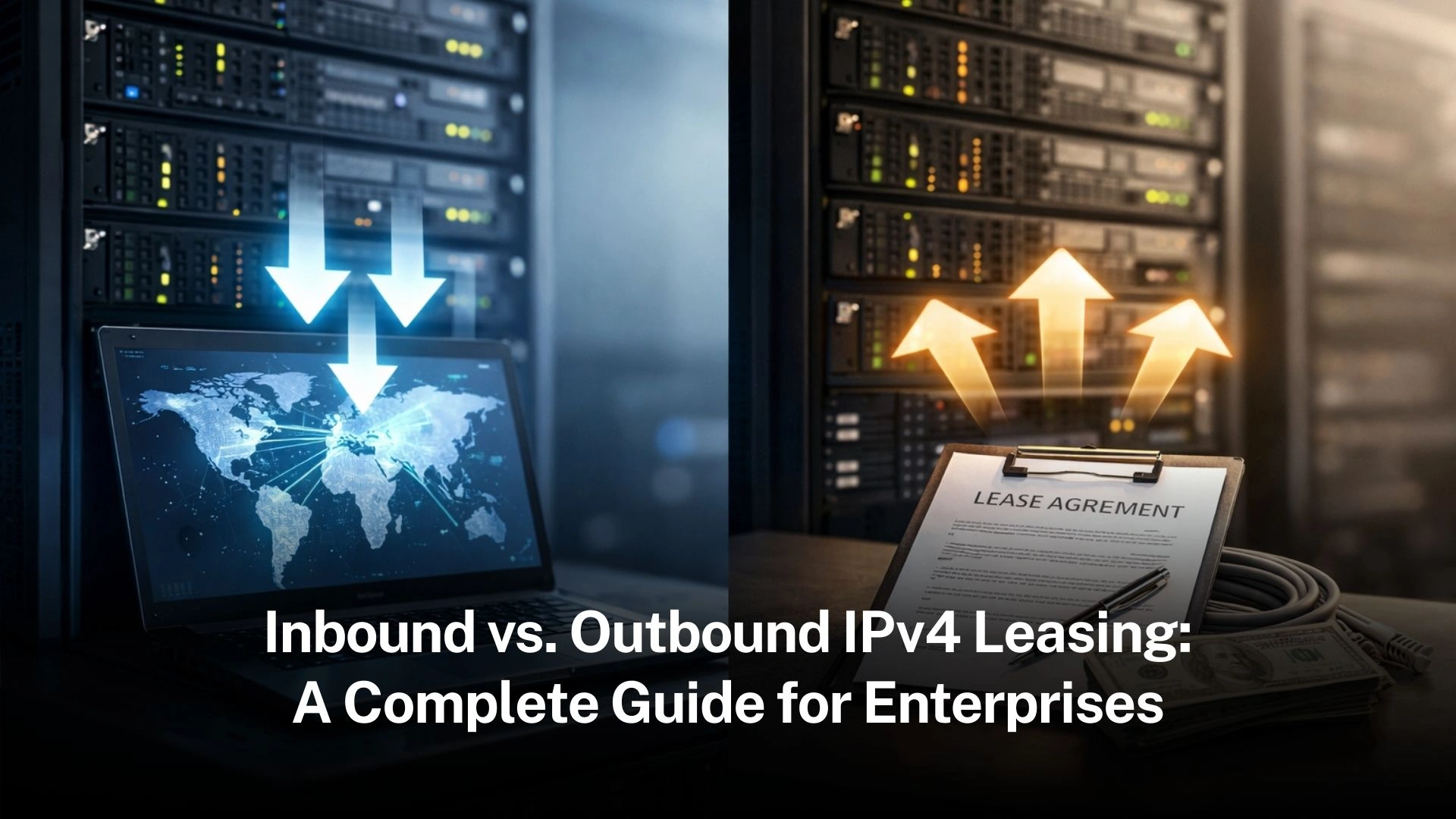
Inbound vs. Outbound IPv4 Leasing: A Complete Guide for Enterprises
Understanding IPv4 leasing helps enterprises manage scarce address space, reducing risk and unlocking strategic growth opportunities in today’s digital economy. Key points Distinguishes between inbound (leasing in) and outbound (leasing out) IPv4 approaches and their strategic implications. Highlights contract structures, registry risk management and continuity considerations affecting global number resources. Inbound vs. outbound IPv4 leasing: complete enterprise guide In the post-exhaustion era of Internet Protocol version 4 (IPv4),Read more Related Posts How much does a /24 IPv4 block cost in 2026? IPv4 scarcity continues to shape internet infrastructure, with /24 blocks still trading actively on global markets despite growing IPv6 adoption. Key Read more The future of IPv4 markets Despite IPv6 expansion, scarcity keeps IPv4 valuable, sustaining a global secondary market where addresses increasingly function as tradable digital assets.Finite Read more Common Myths About Selling IP Addresses The IPv4 secondary market is often shrouded in mystery, leading many organizations to sit on valuable digital assets because they Read more .related-post {} .related-post .post-list { text-align: left; } .related-post .post-list .item { margin: 5px; padding: 10px; } .related-post .headline { font-size: 18px !important; color: #999999 !important; } .related-post .post-list .item .post_thumb { max-height: 220px; margin: 10px 0px; padding: 0px; display: block; } .related-post .post-list .item .post_title { font-size: 16px; color: #3f3f3f; margin: 10px 0px; padding: 0px; display: block; text-decoration: none; } .related-post .post-list .item .post_excerpt { font-size: 13px; color: #3f3f3f; margin: 10px 0px; padding: 0px; display: block; text-decoration: none; } @media only screen and (min-width: 1024px) { .related-post .post-list .item { width: 30%; } } @media only screen and (min-width: 768px) and (max-width: 1023px) { .related-post .post-list .item { width: 90%; } } @media only screen and (min-width: 0px) and (max-width: 767px) { .related-post .post-list .item { width: 90%; } }