What is an Elastic IP address? Complete Guide for AWS Users
 Chan
Chan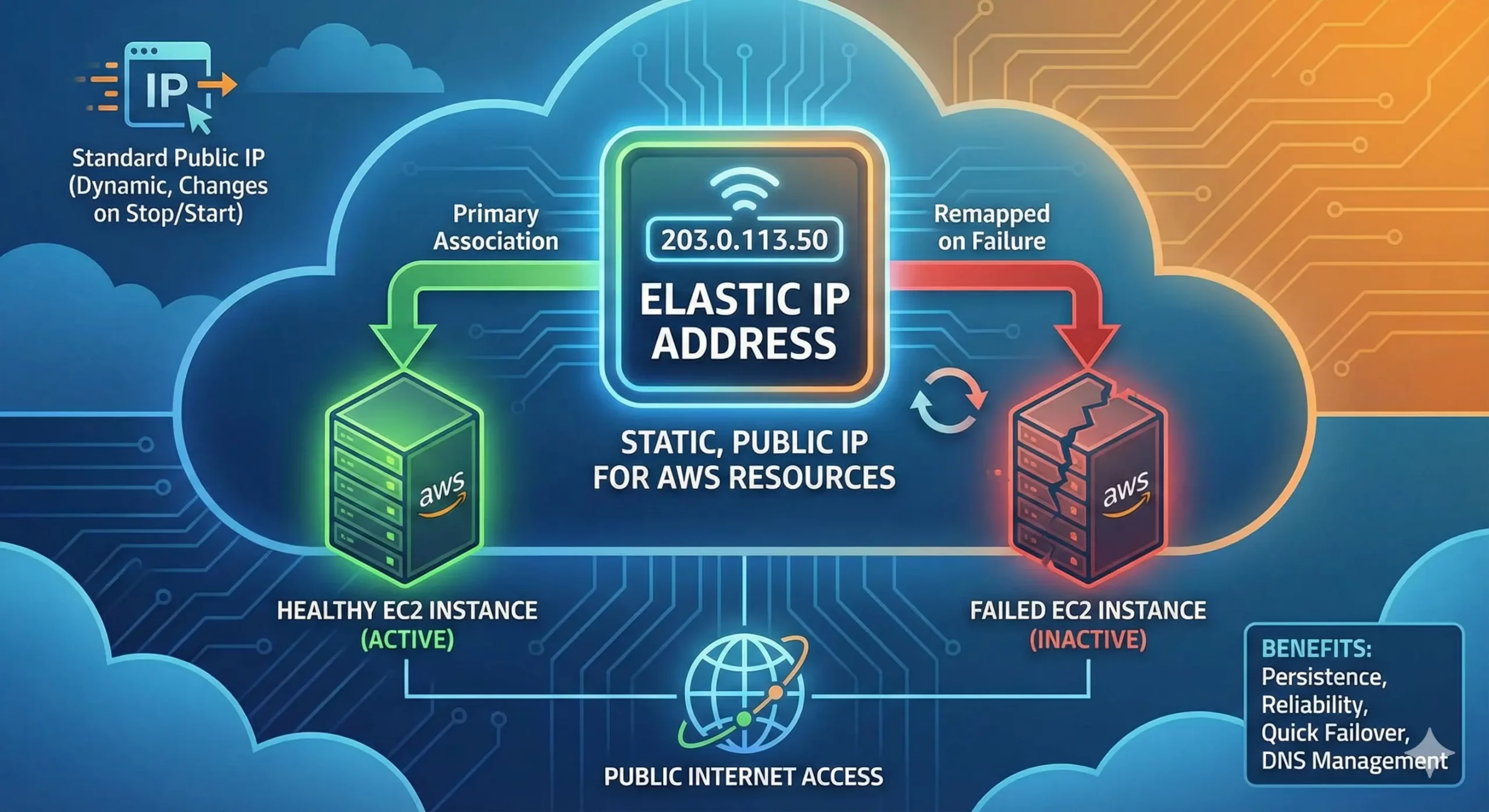
Maintaining a stable IP address in cloud computing is crucial for web hosting, applications, and networking. This is where Elastic IP addresses (EIPs) come into play. If you’re using Amazon Web Services (AWS), understanding how Elastic IPs work can help you improve reliability, prevent downtime, and optimize cloud costs. In this guide, we’ll break down what Elastic IPs are, how they work, their benefits, and best practices.
Table of Contents
What is an Elastic IP Address?
An Elastic IP address is a static, public IPv4 address provided by AWS that you can assign to an Amazon EC2 (Elastic Compute Cloud) instance. Unlike regular public IPs, which change when an instance is restarted, an Elastic IP remains the same, ensuring continuous connectivity.
How Does an Elastic IP Address Work?
Elastic IPs are allocated from AWS’s IP pool and can be associated with an EC2 instance at any time. If an instance fails, you can remap the Elastic IP to another instance, reducing downtime and ensuring uninterrupted service.
🔹 Key Features of Elastic IPs:
✔ Static IP Address: Unlike dynamically assigned public IPs, an Elastic IP stays constant.
✔ Easily Reassignable: You can move an Elastic IP to a different instance within the same AWS region.
✔ Failover Support: If your instance crashes, you can quickly redirect traffic to a backup instance.
✔ Cost Efficiency: You are charged only if the Elastic IP is not associated with a running instance.
Why Use an Elastic IP Address?
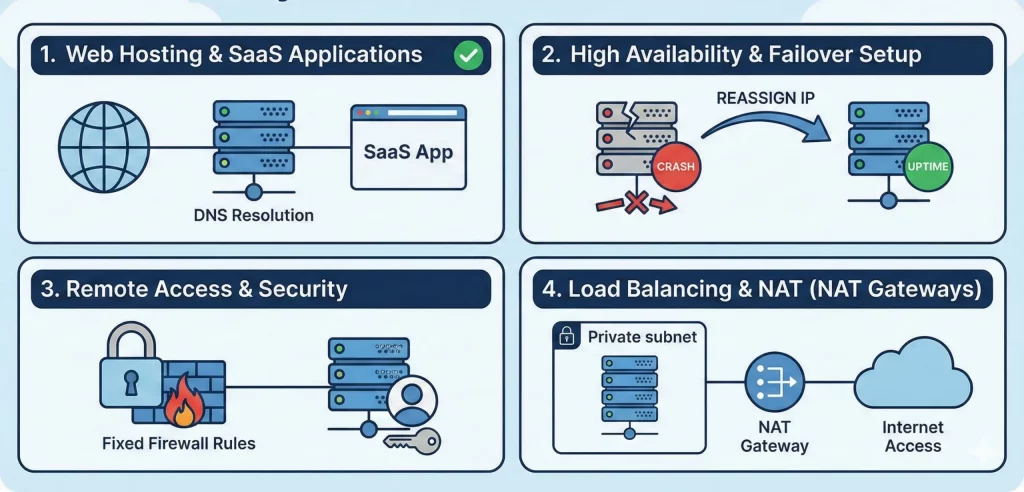
Elastic IPs are ideal for high-availability cloud deployments. Here are some common use cases:
✅ 1. Web Hosting & SaaS Applications
Websites, SaaS applications, and services that require a fixed IP for DNS resolution benefit from Elastic IPs.
✅ 2. High Availability & Failover Setup
If an EC2 instance crashes, you can quickly reassign the Elastic IP to a backup instance, ensuring uptime.
✅ 3. Remote Access & Security
Elastic IPs allow businesses to set fixed firewall rules, ensuring secure access to AWS instances.
✅ 4. Load Balancing & Network Address Translation (NAT)
Elastic IPs are used in NAT Gateways for internet access in private AWS subnets.
Elastic IP vs. Regular Public IP in AWS
An Elastic IP Address in AWS remains persistent, meaning it stays the same even if the associated instance is restarted, whereas a regular public IP changes upon reboot. Elastic IPs can be reassigned to different EC2 instances, making them ideal for high availability and failover scenarios, while regular public IPs are tied to a single instance and cannot be transferred.
In terms of cost, Elastic IPs are free when actively associated with a running instance but incur charges if left idle, whereas regular public IPs remain free as long as the instance is running. Due to these differences, Elastic IPs are preferred for mission-critical applications, while regular public IPs are suited for general-purpose instances.
Best Practices for Using Elastic IPs
To optimize Elastic IP usage, only use them when necessary—if a standard public IP works, stick with it. AWS allows up to 5 Elastic IPs per region, so allocate them wisely. Regularly monitor usage and release idle Elastic IPs to avoid unnecessary costs. For failover automation, leverage AWS Lambda or scripts to reassign Elastic IPs in case of instance failure.
Conclusion
Elastic IPs play a crucial role in cloud networking, failover management, and high-availability setups in AWS. By understanding how Elastic IPs work when to use them, and how to optimize costs, you can ensure a more resilient and cost-effective cloud deployment.
Trusted IPv4 Leasing for Business Growth
Get enterprise-grade IPv4 space quickly, with seamless deployment and end-to-end management.
Get Started with i.leaseRelated Posts
How much does a /24 IPv4 block cost in 2026?
IPv4 scarcity continues to shape internet infrastructure, with /24 blocks still trading actively on global markets despite growing IPv6 adoption. Key points A /24 IPv4 block usually costs between $6,000 and $15,000 in 2026. Cloud providers, hosting companies and SaaS providers need IPv4 addresses so prices stay high. IPv4 addresses are like an asset because they are scarce. What is a /24 IPv4 block A /24 IPv4 blockRead more Related Posts How much does a /24 IPv4 block cost in 2026? IPv4 scarcity continues to shape internet infrastructure, with /24 blocks still trading actively on global markets despite growing IPv6 adoption. Key Read more The future of IPv4 markets Despite IPv6 expansion, scarcity keeps IPv4 valuable, sustaining a global secondary market where addresses increasingly function as tradable digital assets.Finite Read more Common Myths About Selling IP Addresses The IPv4 secondary market is often shrouded in mystery, leading many organizations to sit on valuable digital assets because they Read more .related-post {} .related-post .post-list { text-align: left; } .related-post .post-list .item { margin: 5px; padding: 10px; } .related-post .headline { font-size: 18px !important; color: #999999 !important; } .related-post .post-list .item .post_thumb { max-height: 220px; margin: 10px 0px; padding: 0px; display: block; } .related-post .post-list .item .post_title { font-size: 16px; color: #3f3f3f; margin: 10px 0px; padding: 0px; display: block; text-decoration: none; } .related-post .post-list .item .post_excerpt { font-size: 13px; color: #3f3f3f; margin: 10px 0px; padding: 0px; display: block; text-decoration: none; } @media only screen and (min-width: 1024px) { .related-post .post-list .item { width: 30%; } } @media only screen and (min-width: 768px) and (max-width: 1023px) { .related-post .post-list .item { width: 90%; } } @media only screen and (min-width: 0px) and (max-width: 767px) { .related-post .post-list .item { width: 90%; } }
The future of IPv4 markets
Despite IPv6 expansion, scarcity keeps IPv4 valuable, sustaining a global secondary market where addresses increasingly function as tradable digital assets. Finite IPv4 supply has created a mature secondary market where address blocks are bought, sold and leased worldwide. Prices fluctuate, but persistent demand from cloud, hosting and AI infrastructure suggests IPv4 markets will remain active for years. What happened The rise of a digital commodity The global market forRead more Related Posts How much does a /24 IPv4 block cost in 2026? IPv4 scarcity continues to shape internet infrastructure, with /24 blocks still trading actively on global markets despite growing IPv6 adoption. Key Read more The future of IPv4 markets Despite IPv6 expansion, scarcity keeps IPv4 valuable, sustaining a global secondary market where addresses increasingly function as tradable digital assets.Finite Read more Common Myths About Selling IP Addresses The IPv4 secondary market is often shrouded in mystery, leading many organizations to sit on valuable digital assets because they Read more .related-post {} .related-post .post-list { text-align: left; } .related-post .post-list .item { margin: 5px; padding: 10px; } .related-post .headline { font-size: 18px !important; color: #999999 !important; } .related-post .post-list .item .post_thumb { max-height: 220px; margin: 10px 0px; padding: 0px; display: block; } .related-post .post-list .item .post_title { font-size: 16px; color: #3f3f3f; margin: 10px 0px; padding: 0px; display: block; text-decoration: none; } .related-post .post-list .item .post_excerpt { font-size: 13px; color: #3f3f3f; margin: 10px 0px; padding: 0px; display: block; text-decoration: none; } @media only screen and (min-width: 1024px) { .related-post .post-list .item { width: 30%; } } @media only screen and (min-width: 768px) and (max-width: 1023px) { .related-post .post-list .item { width: 90%; } } @media only screen and (min-width: 0px) and (max-width: 767px) { .related-post .post-list .item { width: 90%; } }
Inbound vs. Outbound IPv4 Leasing: A Complete Guide for Enterprises
Understanding IPv4 leasing helps enterprises manage scarce address space, reducing risk and unlocking strategic growth opportunities in today’s digital economy. Key points Distinguishes between inbound (leasing in) and outbound (leasing out) IPv4 approaches and their strategic implications. Highlights contract structures, registry risk management and continuity considerations affecting global number resources. Inbound vs. outbound IPv4 leasing: complete enterprise guide In the post-exhaustion era of Internet Protocol version 4 (IPv4),Read more Related Posts How much does a /24 IPv4 block cost in 2026? IPv4 scarcity continues to shape internet infrastructure, with /24 blocks still trading actively on global markets despite growing IPv6 adoption. Key Read more The future of IPv4 markets Despite IPv6 expansion, scarcity keeps IPv4 valuable, sustaining a global secondary market where addresses increasingly function as tradable digital assets.Finite Read more Common Myths About Selling IP Addresses The IPv4 secondary market is often shrouded in mystery, leading many organizations to sit on valuable digital assets because they Read more .related-post {} .related-post .post-list { text-align: left; } .related-post .post-list .item { margin: 5px; padding: 10px; } .related-post .headline { font-size: 18px !important; color: #999999 !important; } .related-post .post-list .item .post_thumb { max-height: 220px; margin: 10px 0px; padding: 0px; display: block; } .related-post .post-list .item .post_title { font-size: 16px; color: #3f3f3f; margin: 10px 0px; padding: 0px; display: block; text-decoration: none; } .related-post .post-list .item .post_excerpt { font-size: 13px; color: #3f3f3f; margin: 10px 0px; padding: 0px; display: block; text-decoration: none; } @media only screen and (min-width: 1024px) { .related-post .post-list .item { width: 30%; } } @media only screen and (min-width: 768px) and (max-width: 1023px) { .related-post .post-list .item { width: 90%; } } @media only screen and (min-width: 0px) and (max-width: 767px) { .related-post .post-list .item { width: 90%; } }